The Trellis Method
A method, not a template.
Trellis runs the Trellis Method, Greta Hager’s method for turning a strategy into work that visibly delivers it. It has seven elements. Each one has a rule, and the rules are what most plans quietly break.
- 1Vision
- 2Values
- 3Focus areas
- 4Objectives
- 5Measures
- 6Projects
- 7The management system
- back to the vision
The seven elements, and the rule each one carries
1Vision
Where the company is going, five to ten years out. Ambitious, but something the team could genuinely reach.
One sentence. No buzzwords. It should be recognisably yours and nobody else’s.
In Trellis · The plan coach flags a vision longer than a sentence, or one with no horizon set.
2Values
How people behave while they chase the vision. Values give the team a common purpose and set the boundaries.
They matter as much as the numbers. A plan hit the wrong way is not a plan hit.
In Trellis · Values sit beside the vision at the top of the plan and of the one-page scorecard.
3Focus areas
Three to five themes that say where the effort goes. Narrower than the vision, and written to motivate.
No metrics, no deadlines. The moment a theme gets a date it has become an objective.
In Trellis · Focus areas carry no dates or measures by design, and the coach flags fewer than three or more than five.
4Objectives
What the company will have achieved, stated as a measurable outcome with a deadline, usually about three years out.
Three to six under each focus area, and one accountable leader for each.
In Trellis · Every objective has a named owner, and the coach flags more than six under one focus area.
5Measures
The numbers that show whether an objective is moving. A mix of leading measures, which let you steer, and lagging ones, which confirm the result.
Measures belong to objectives, never to projects. Outcomes have numbers; work has milestones.
In Trellis · Every reading carries its date and its author, is never overwritten, and goes visibly stale when it ages.
6Projects
The work that moves an objective: named steps, dates, and people whose time is committed to it.
Every project serves an objective. An objective no project serves is a wish.
In Trellis · Work tied to no objective, and objectives nobody is working on, both show as gaps.
7The management system
The rhythm that keeps the plan alive: regular meetings, one page everyone can read, and teams aligned to it.
Two kinds of meeting. A review asks whether the work is moving. A refresh asks whether the plan is still right.
In Trellis · Reviews and refreshes run on separate clocks, and each meeting is filed as a locked record.
The test
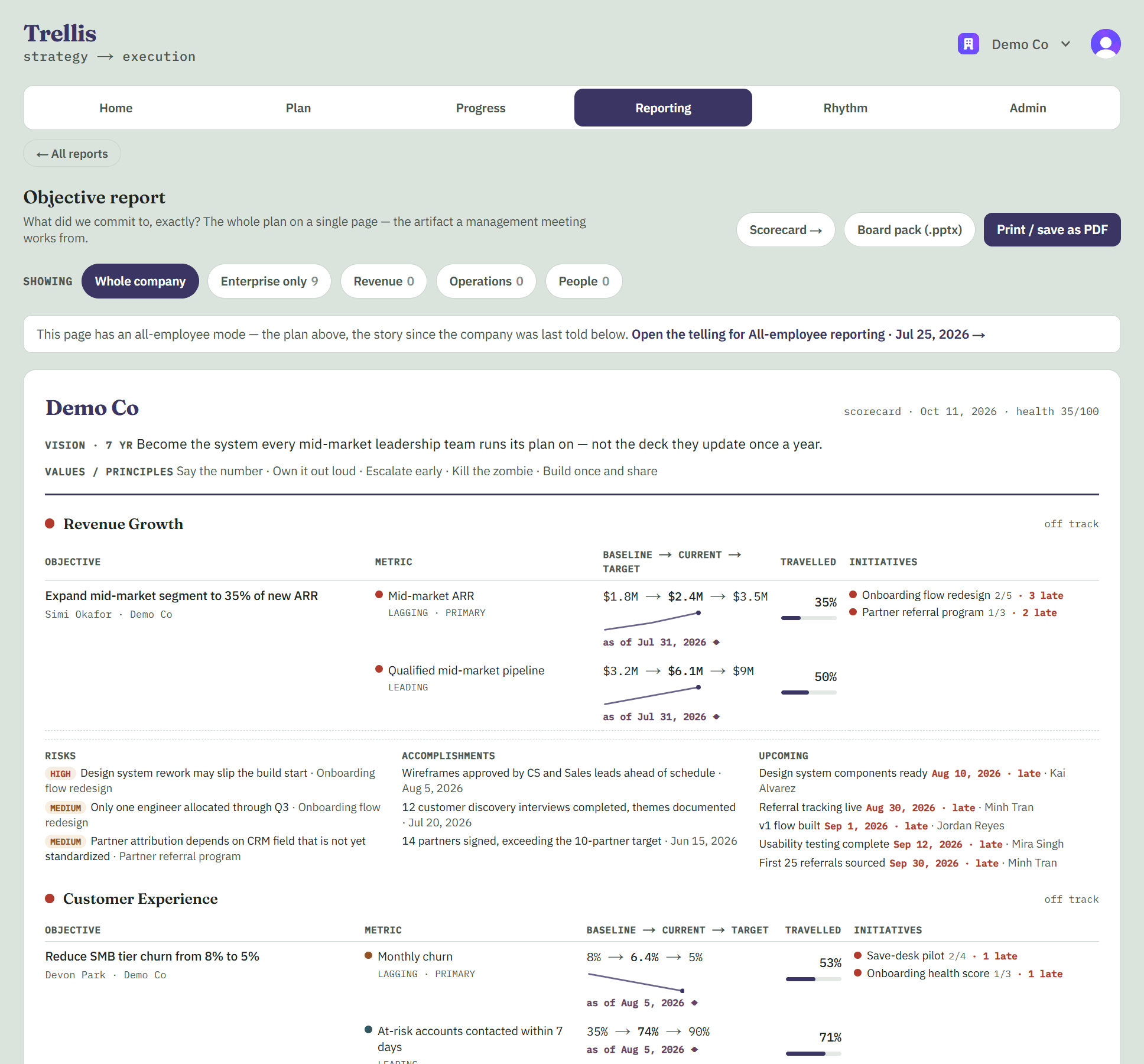
You have a clear plan when it fits on one page.
Vision, values and focus areas across the top. Underneath, one row per objective: its measures, their targets, and the projects doing the work. If your plan won’t fit on that page, it isn’t finished. If it does, that page is what your leadership meetings should run from, and Trellis builds it from the plan itself.
Take it with you
The Trellis Method on one page.
The seven elements and their rules on a single printable page, for your next leadership offsite.
See your own plan in Trellis.
30-day trial · No card · Everyone in your company can view for free